oxaion for
Purchasing
oxaion views procurement as an integral overall process that also encompasses delivery services, quality assurance, the involvement of suppliers in technical innovations, and much more—thereby actively increasing your competitiveness.
-
The following processes can be handled end-to-end in oxaion's purchasing module: purchase requisitions, inquiries and quotations, order processing, goods receipt, quality control, invoice verification, dunning/procurement controlling
-
The purchasing module of the ERP software underscores the importance of complete ERP integration. Information from other areas automatically triggers ordering processes as needed, either directly or via order proposals that require approval. The information obtained in purchasing about suppliers, delivery terms, etc. flows back into the other programs so that, for example, a project administrator in the project management module immediately knows about prices and delivery times.
-
This also includes convenient support for the so-called extended workbench, made possible by smooth interaction between purchasing and production. Entries in work plans that identify certain work steps as external orders automatically generate the corresponding purchase orders. Of course, it is possible to send orders of any kind electronically (EDIFACT, email, e-fax).
oxaion provides various tools for graphical and tabular representation of all evaluations and statistics relating to purchasing.
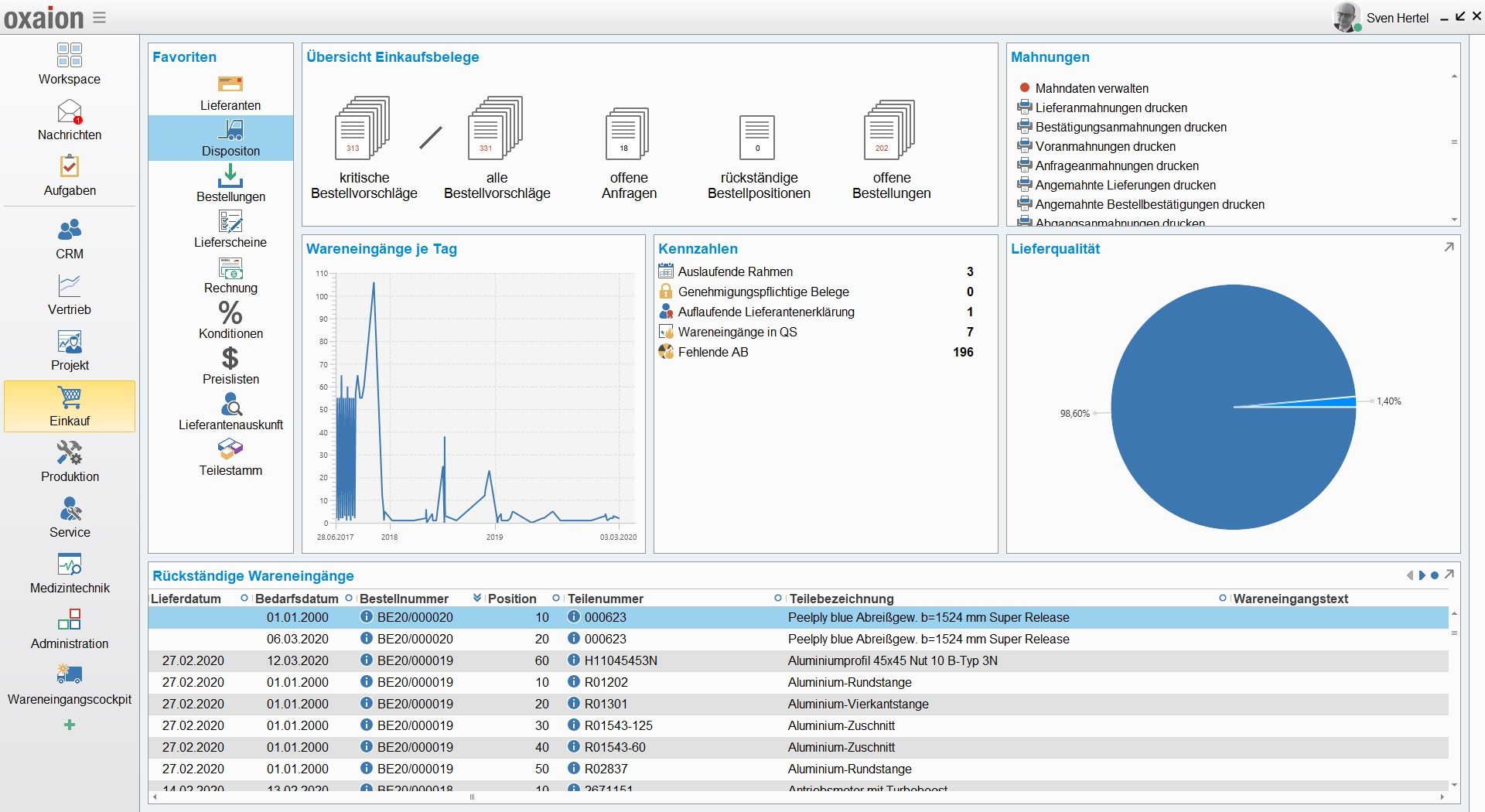
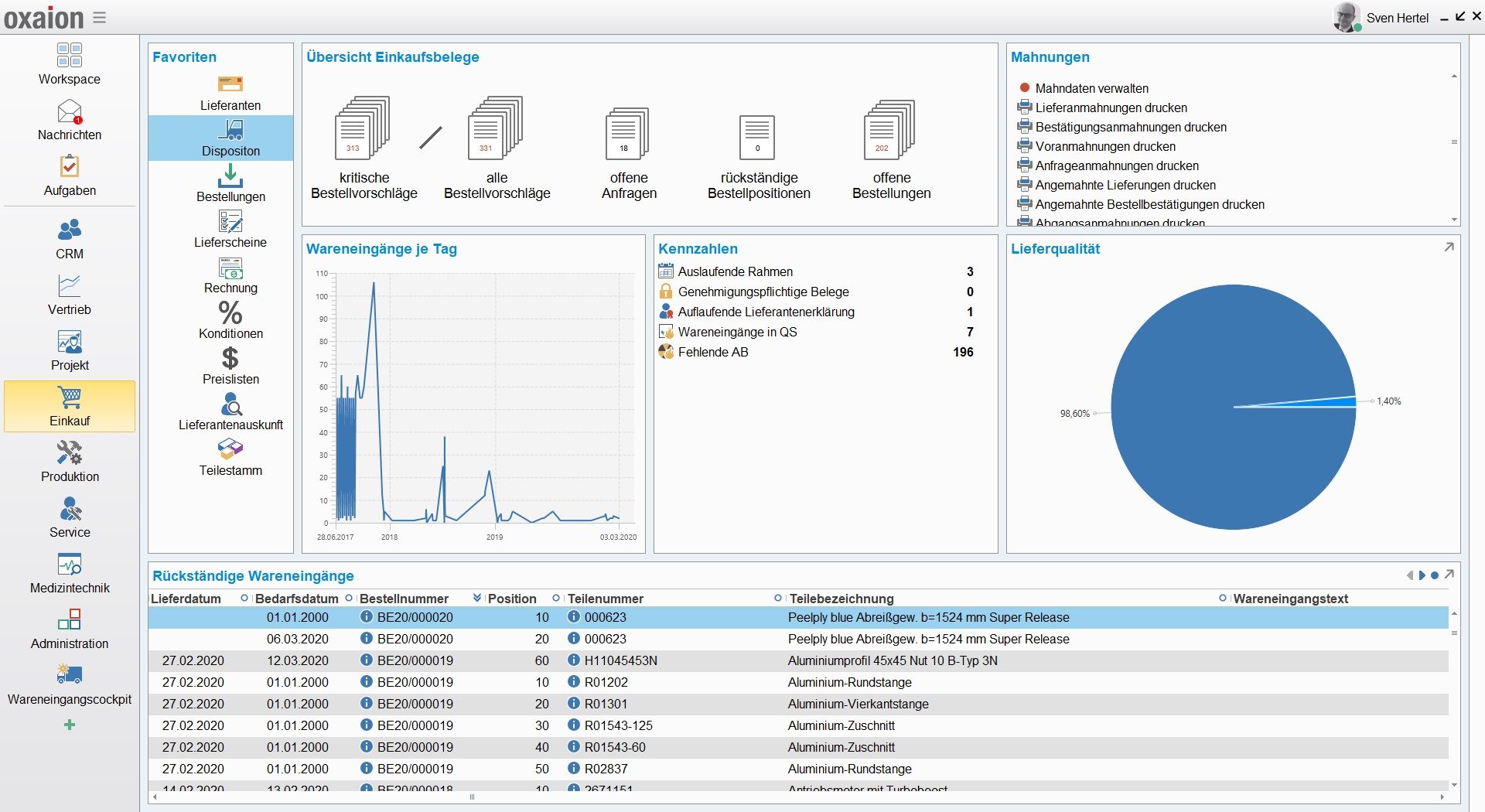 Fig.: Purchasing staff receive order suggestions as soon as the system identifies a need for purchased parts.
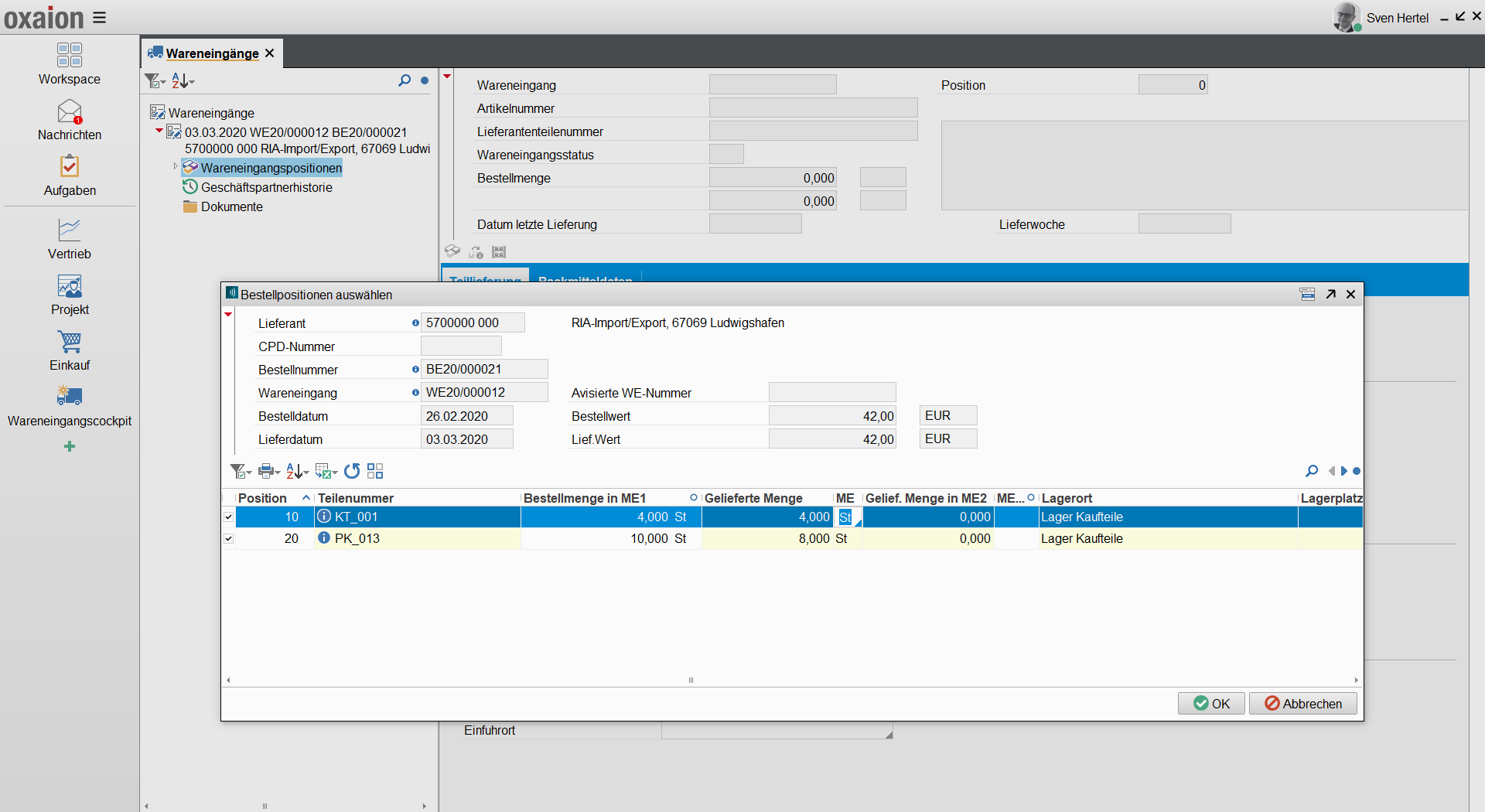
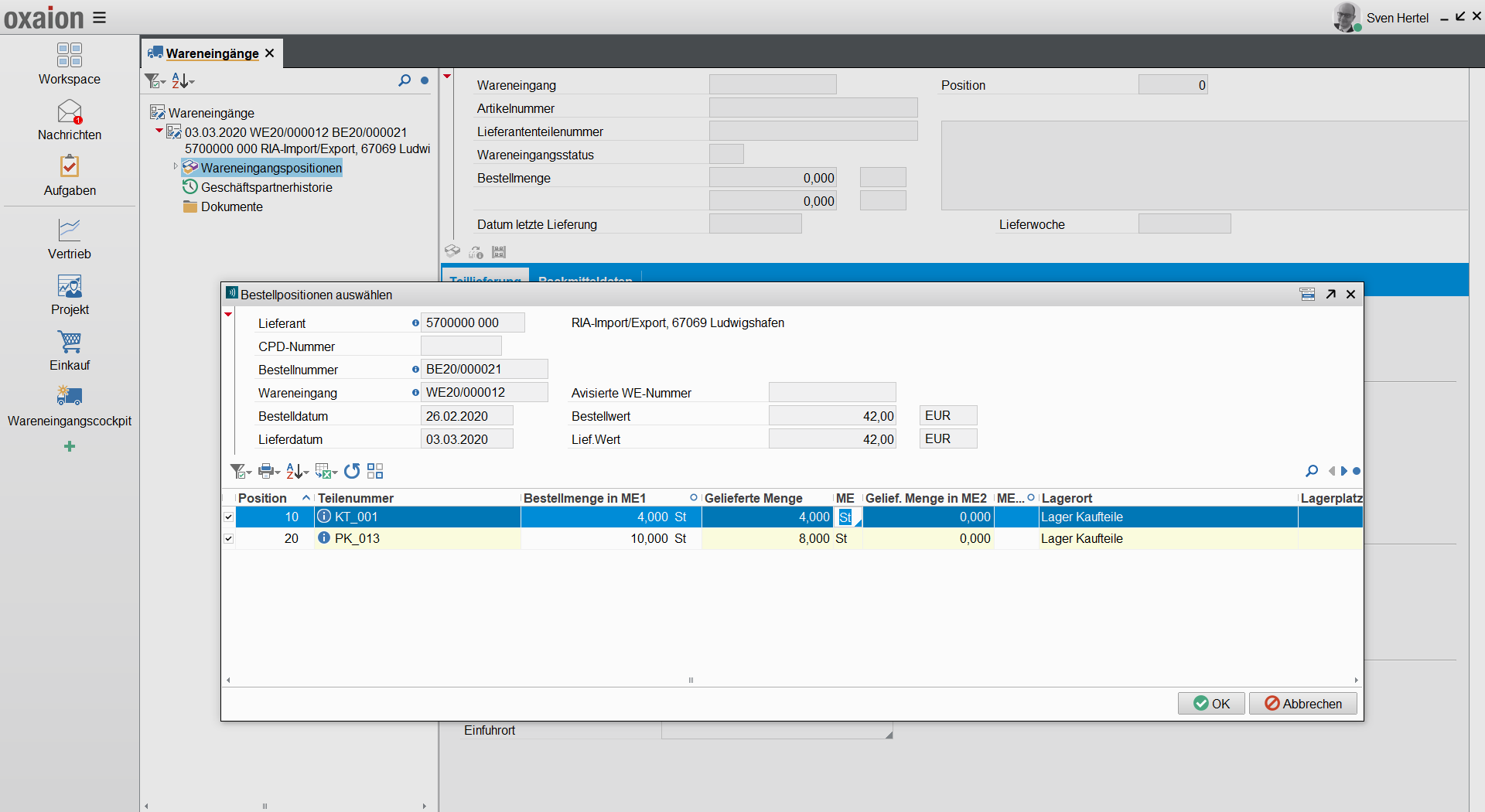 Fig.: Goods receipt – all order items at a glance
ERP software for
scheduling
oxaion integrates scheduling into a coordinated strategy that spans all areas of the company.
This allows you to avoid any risk of your delivery targets being jeopardized by "under-supply" in your inventory. oxaion guarantees all the essential factors: flexible, demand-oriented planning, accurate inventory management, up-to-date information on the procurement markets, resource planning, and in-house production.
planning process
-
Material planning can only be implemented with the help of different planning methods. Special circumstances, such as long replacement times or high-value purchased parts, require different approaches.
-
The planning procedure compares the demand from customer orders with the corresponding offers from warehousing, purchasing, and production. oxaion supports Kanban control, consumption, demand, and plan control procedures, as well as discrete individual planning.
-
Consumption-driven planning is used where there is regular consumption of relatively low-value parts. Integrated inventory monitoring ensures that there is always enough stock available.
-
For higher-value items, those with long replacement times, or items with fluctuating demand, demand-driven planning with integrated undercoverage checks is recommended.
-
Parts with particularly long replacement times are planned if there is no actual demand at the time of procurement. This is determined from planned figures. oxaion automatically switches between demand-driven and plan-driven control with the help of a freely definable timer.
-
For discretely controlled parts, each demand leads to a corresponding order or production proposal that specifically covers this demand.
-
Kanban control is often applied as a 2-box principle. If a box is empty, the process of refilling the box is initiated. The ERP software supports the printing of the control card, container tracking, and the automatic generation of the production order or purchase order.
-
With oxaion's ERP system for materials management, you have an overview of material planning.
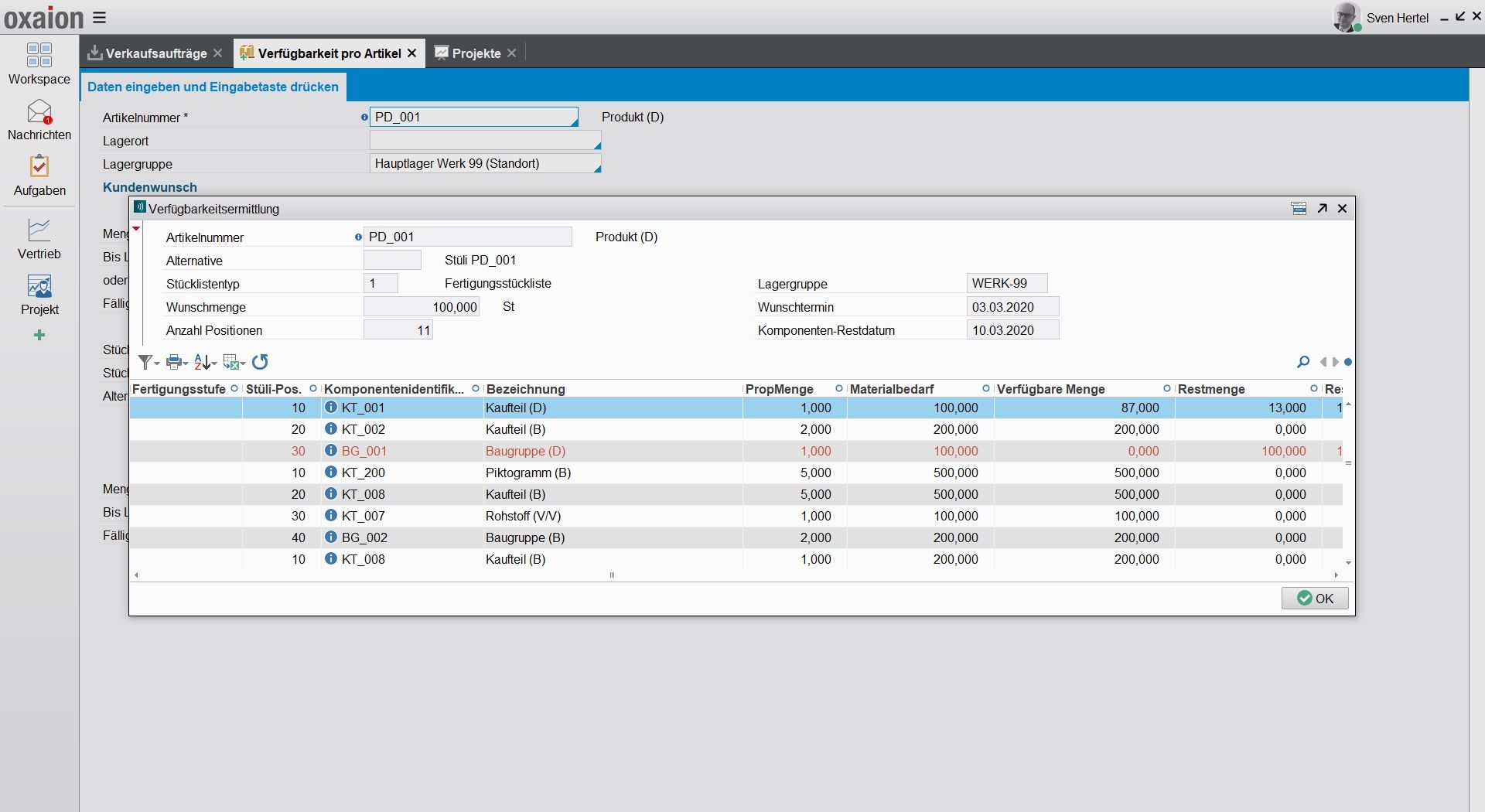 Fig.: Availability check for all components of a bill of materials
planning parameters
-
The disposition parameters specify which actions are required in which forms in the event of a shortage.
-
Lot size formulas define how large the quantity for the procurement proposal should be in the event of a shortage. The system can generate summaries for each item and warehouse group over a specific period of time, depending on ABC indicators. Quantity restrictions such as packaging units or minimum quantities from a supplier are also taken into account.
-
Parameters such as safety times or periods to be planned by the MRP are stored in the ordering policy key.
-
Make or buy? A special indicator shows whether a part is manufactured in-house or sourced externally. In the case of external sourcing, oxaion assists in finding suppliers and creates purchase order, production, or transfer proposals.
-
The system allows dynamic adjustment of weekly consumption, reorder point, replenishment times, and other parameters. The user can choose between automatic and manual updates.
Analyses and evaluations
-
Whether it's a customer inquiry about the availability of a product or a supplier postponing a delivery date, the planning department must quickly assess the possible implications and requires a high level of qualified information to do so.
-
The net overview shows the demand and supply situation in a freely selectable period. From here, the planner can then access all relevant data, edit it specifically using filters, and get an overview of the worklist.
-
The availability check for parts is carried out depending on their scheduling procedure. The scheduler enters a desired quantity and a desired date; the oxaion ERP software determines the available quantity on this date and the earliest possible date on which the remaining quantity can be made available.
oxaion provides various tools for graphical and tabular representation of all evaluations and statistics relating to scheduling.
oxaion for
the warehouse
oxaion offers a wide variety of functions and options for inventory management in the warehouse. Here too, integration and flexibility are the benchmarks for simple, efficient work.
-
oxaion takes into account all warehouse requirements in terms of serving as a hub for purchasing, sales, materials management, cost accounting, service, and production planning.
-
In order to implement inventory management that is optimally tailored to the company, oxaion supports several types of warehouses. These include: passive chaotic warehouse (PCL), active chaotic warehouse (ACL), and fixed location control.
-
All common storage and retrieval methods are available for warehouse control.
oxaion provides various tools for graphical and tabular representation of all evaluations and statistics relating to the warehouse.
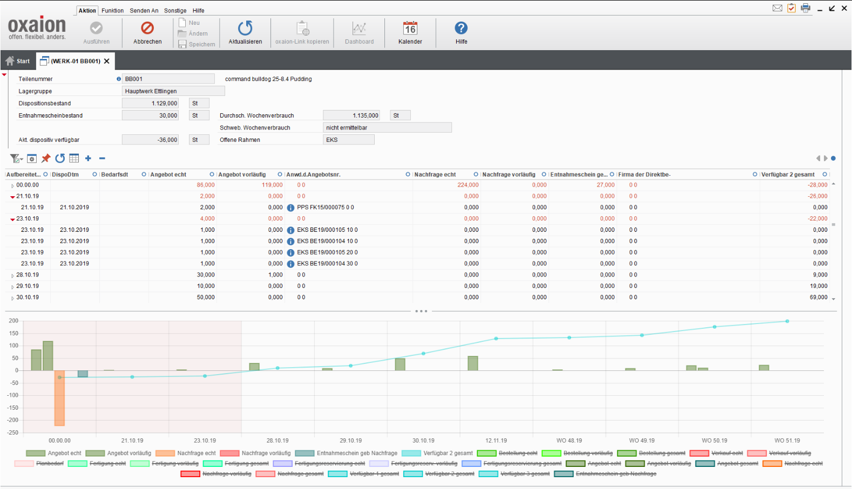
 Fig.: Example of a stock disposition overview
shipping
shipping logistics
-
The high level of integration with other functional areas allows for constant monitoring of order progress. This enables targeted delivery.
-
Order picking in oxaion allows for different picking strategies. These can include, for example, a tiered priority model or allocation according to shipping methods or routes. In any case, the picking documents are designed in such a way that unnecessary trips in the warehouse are avoided.
-
If cross-client shipments are provided, the software supports this with corresponding picking slips. When processing deliveries, the data stored in the order is used. This allows the form of the delivery note to be controlled via the various order types. Groups are formed to generate collective delivery notes.
-
For the service providers DPD (DELISprint) and UPS (WorldShip), oxaion offers a standard interface and generates the necessary documents.
-
With the help of package management, shipments consisting of multiple packages can be optimally prepared. Weight and volume restrictions are automatically taken into account.
-
Loading slip management ensures that different delivery notes, which can also be generated across clients, are grouped together with a view to optimizing delivery routes.
returns processing
-
When customers return goods, oxaion generates a credit note which is forwarded to the financial accounting department after approval.
-
For complex return processing procedures, users can rely on the convenient RMA procedure (RMA = Return Material Authorization).